If you have searched for Nadi Astrology, you may have come across the term Olai Chuvadi, or Nadi palm leaf. These traditional palm-leaf manuscripts are closely associated with the practice of Nadi Astrology in Tamil Nadu and are also part of the wider history of palm-leaf manuscript traditions in South India.
But what exactly is an Olai Chuvadi? How were palm leaves prepared for writing? How have they survived for generations? And how can someone approach claims about the authenticity of a Nadi palm leaf?
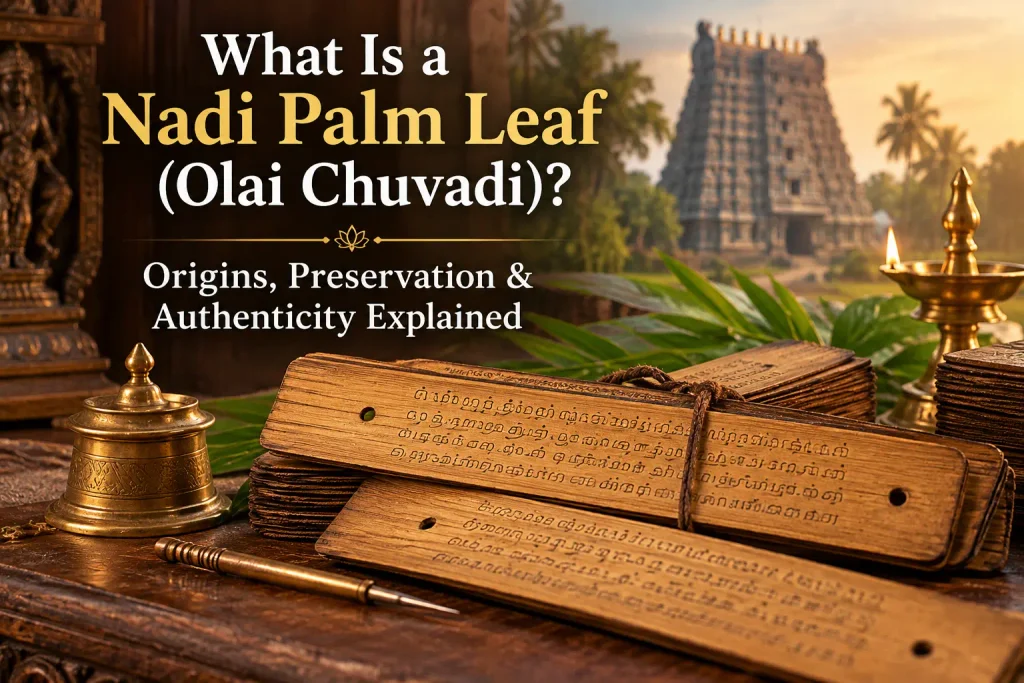
This guide explains the Nadi palm leaf tradition, its origins, physical characteristics, preservation methods, and practical points to consider when evaluating authenticity.
What Is an Olai Chuvadi?
Olai Chuvadi is a Tamil term associated with a palm-leaf manuscript. “Olai” refers to a palm leaf, while “Chuvadi” refers to a written manuscript or record.
Before paper became widely available, palm leaves were used across South Asia as a writing material for different types of knowledge. Manuscripts could contain literature, religious texts, medical knowledge, mathematics, astronomy, philosophy and other subjects.
The Nadi palm leaf tradition is one particular cultural use of this manuscript medium.
It is important to distinguish the physical manuscript from the beliefs associated with it. The existence of palm-leaf manuscripts is a historical and documented fact. Claims that particular manuscripts contain predictions written thousands of years ago belong to the traditional Nadi Astrology belief system and should be understood in that cultural context.
India continues to have a substantial manuscript heritage. The National Mission for Manuscripts has documented millions of manuscripts and has undertaken conservation and digitization work across the country.
What Is a Nadi Palm Leaf Used For?
Within Nadi Astrology, practitioners traditionally use palm-leaf manuscripts as the textual basis for a reading.
The traditional process generally involves identifying a relevant manuscript from a collection and then interpreting the verses associated with the seeker.
A Nadi reading may discuss areas such as:
- Family and personal background
- Education and career
- Marriage and relationships
- Financial circumstances
- Health-related themes
- Family members
- Spiritual practices
- Traditional remedies
The exact structure can differ between Nadi centres and lineages.
A useful point for readers is that the palm leaf itself is not the same thing as the interpretation. The physical manuscript is a historical object, while the reading involves the practitioner’s ability to identify, read and interpret the text.
This distinction helps people understand what they are actually experiencing during a Nadi Astrology consultation.
Where Did Nadi Palm Leaf Manuscripts Come From?
The origins of Nadi palm leaves are closely connected with the wider palm-leaf manuscript culture of South India.
Traditional Nadi accounts often associate particular manuscripts with sages such as Agastya, although different Nadi traditions may attribute texts differently.
Historical manuscript research also shows that palm leaves were widely used as writing materials in India. Tamil Nadu is one of the regions known for significant manuscript collections. IGNCA’s documentation of India’s manuscript heritage identifies Tamil Nadu among the states with major manuscript resources.
However, there is an important distinction between:
Historical evidence: Palm-leaf manuscripts were widely used to preserve written knowledge in South India.
Traditional belief: Nadi practitioners and followers traditionally believe that certain Nadi manuscripts contain records associated with sages and individual destinies.
Keeping these two perspectives separate makes an explanation of Nadi palm leaves more useful and trustworthy.
How Are Palm Leaves Prepared for Writing?
A palm leaf cannot simply be taken from a tree and immediately used as a manuscript.
Traditional palm-leaf preparation involves several stages intended to make the material suitable for writing and storage.
Depending on the regional tradition and historical period, preparation can include:
- Selecting suitable mature leaves.
- Cutting the leaves into usable sections.
- Cleaning and treating the material.
- Drying the leaves carefully.
- Flattening and preparing the surface.
- Cutting the leaves into a consistent manuscript format.
- Creating holes for stringing or binding.
- Inscribing the text using a writing instrument.
- Applying a substance that helps make the inscription visible.
- Storing the completed leaves as a bundle.
The writing process is different from writing on modern paper with ink. Text was traditionally incised into the leaf surface, after which the markings could be treated so that the characters became easier to see.
This physical construction explains why old palm-leaf manuscripts require careful handling.
How Are Nadi Palm Leaves Preserved?
Preserving palm leaves is challenging because palm leaf is an organic material.
Heat, moisture, insects, dust, fungus, unsuitable storage conditions and excessive handling can damage manuscripts over time. The National Mission for Manuscripts specifically identifies insects, fungus, brittleness and fading among the problems affecting Indian manuscript collections.
Traditional preservation practices have included the use of natural materials and controlled storage. India’s manuscript conservation work also combines indigenous knowledge with modern conservation methods.
The National Mission for Manuscripts recommends protecting manuscripts from direct exposure to moisture, dust, insects and excessive light, while maintaining suitable environmental conditions and proper storage.
Modern preservation can also involve:
- Documentation
- Conservation treatment
- Controlled storage
- Digitization
- Cataloguing
- Microfilming
- Digital archiving
India’s national manuscript initiatives demonstrate why preservation is not simply about keeping an old object in a cupboard. Proper conservation requires documentation, suitable environmental conditions and trained specialists.
Why Do Nadi Palm Leaves Need Regular Preservation?
Palm leaves naturally deteriorate.
Unlike stone or metal, palm leaf is vulnerable to environmental changes and biological damage. Even when a manuscript has survived for a long period, it does not mean that it can remain unchanged indefinitely.
This is one reason manuscript traditions historically depended on careful custody and, in some traditions, the transmission or recopying of texts.
For someone visiting a Nadi centre, the important question is therefore not simply:
“Does this leaf look old?”
A better question is:
“How has this manuscript collection been maintained, documented and transmitted?”
The physical age of an individual leaf can be difficult for an ordinary visitor to establish simply by looking at it.
How Can You Check the Authenticity of a Nadi Palm Leaf?
Authenticity is one of the most common questions people have before consulting Nadi Astrology.
There is no simple visual test that allows a visitor to look at a palm leaf and conclusively determine its historical authenticity.
Instead, consider several factors together.
1. Ask About the Manuscript Collection
A credible centre should be able to explain where its manuscript collection comes from and how it has been maintained.
Questions about lineage, custodianship and preservation practices can provide useful context.
2. Look for a Clear Reading Process
Ask how the centre identifies the relevant manuscript and how the practitioner verifies the information during the consultation.
A transparent explanation is more useful than vague claims about authenticity.
3. Understand the Difference Between Tradition and Historical Proof
Statements about sages, ancient predictions or the age of particular manuscripts should be presented as traditional claims unless supported by independent historical or scientific evidence.
This distinction is especially important when evaluating online claims.
4. Examine Preservation Practices
A centre responsible for old palm-leaf manuscripts should take reasonable care of its collection.
Proper storage, controlled environmental conditions, careful handling and documentation are all relevant to manuscript preservation.
5. Avoid Absolute Guarantees
Be cautious of claims that promise certainty about every aspect of your future or present a spiritual tradition as scientifically proven without supporting evidence.
A responsible explanation should clearly distinguish traditional belief, manuscript heritage and personal interpretation.
Can a Nadi Palm Leaf Be Digitized?
Yes. Digitization is now an important part of manuscript preservation.
Digitization allows fragile manuscripts to be photographed or scanned so that their contents can be studied without repeatedly handling the original material.
The Government of India’s manuscript initiatives have placed significant emphasis on digitization and wider access. As of 2024, the National Mission for Manuscripts reported documenting around 5.2 million manuscripts, conserving approximately 90 million folios and digitizing 3.5 lakh manuscripts containing about 3.5 crore pages.
In 2026, the Gyan Bharatam Mission continued this broader national effort to survey, document, conserve and digitize manuscript collections, including manuscripts held in private collections and institutions.
Digitization does not replace the historical value of the original palm leaf. Instead, it creates another way to preserve information and support research.
Nadi Palm Leaf vs Modern Printed Astrology Material
One of the easiest ways to understand an Olai Chuvadi is to compare it with modern astrology publications.
| Nadi Palm Leaf | Modern Astrology Material |
| Traditional palm-leaf manuscript | Usually printed or digital |
| Inscribed on prepared palm leaf | Produced using modern printing or software |
| Part of a historical manuscript tradition | Modern publishing format |
| Requires careful physical preservation | Easier to reproduce |
| Traditionally interpreted by practitioners | Often read directly by the user |
The key difference is the physical manuscript tradition behind the Nadi palm leaf.
What Should You Know Before a Nadi Astrology Reading?
If you are considering a Nadi Astrology consultation, learning about the Olai Chuvadi beforehand can help you understand the process better.
You can ask:
- What type of Nadi manuscript tradition does the centre follow?
- How are the leaves preserved?
- How is a manuscript identified?
- What language or script is used?
- Who interprets the manuscript?
- How are traditional claims explained?
- Is the consultation presented as spiritual guidance rather than a guaranteed outcome?
These questions can help you approach the experience with realistic expectations.
Nadi Astrology is a traditional spiritual practice. Whether someone views it as a form of spiritual guidance, cultural heritage or personal belief is ultimately an individual matter.
Frequently Asked Questions About Nadi Palm Leaves
What does Olai Chuvadi mean?
Olai Chuvadi refers to a palm-leaf manuscript in Tamil. In the Nadi Astrology tradition, it commonly refers to the palm-leaf manuscripts used as the basis for traditional readings.
Are Nadi palm leaves real?
Palm-leaf manuscripts are a real and well-documented form of historical writing material. Whether a particular leaf contains a specific person’s predicted life record is a separate traditional claim that cannot be established simply from the physical appearance of the leaf.
How old are Nadi palm leaves?
The age of individual Nadi leaves varies and should not automatically be assumed to be thousands of years old. Palm-leaf manuscripts require ongoing preservation and, in manuscript traditions, texts may be transmitted through later copies.
How are palm-leaf manuscripts preserved?
They can be protected through suitable storage, environmental control, careful handling, insect management, conservation treatment and digitization. India’s manuscript conservation guidance emphasizes protection from moisture, dust, insects and excessive light.
What language are Nadi palm leaves written in?
Nadi manuscripts associated with Tamil traditions are commonly connected with older forms of Tamil writing and verse. The exact script and language characteristics can vary according to the manuscript tradition and period.
Can anyone read an Olai Chuvadi?
Reading an old palm-leaf manuscript requires knowledge of the relevant script, language and manuscript tradition. In Nadi Astrology, interpretation is traditionally carried out by practitioners trained within particular lineages.
Final Thoughts
The Nadi palm leaf, or Olai Chuvadi, is more than an object associated with astrology. It belongs to the wider history of palm-leaf manuscript culture in South India.
Understanding how palm leaves were prepared, written, preserved and transmitted gives a clearer picture of the tradition. At the same time, separating documented manuscript history from traditional spiritual claims helps readers evaluate information more carefully.
For anyone exploring Nadi Astrology, learning about the physical manuscript is a useful first step. It provides context for understanding the traditional reading process while respecting both India’s manuscript heritage and the beliefs surrounding Nadi traditions.
As India’s manuscript-preservation programmes continue to document and digitize historical collections, palm-leaf manuscripts remain an important part of the country’s cultural and textual heritage.