Nadi Astrology Kandams are different chapters or sections of a traditional Nadi palm-leaf reading. Each Kandam focuses on a particular area of life, such as family, education, marriage, career, health, finances, children, spiritual matters, and remedies.
A Nadi reading usually begins with a general assessment before moving into specific Kandams. The exact naming, order, and interpretation can vary between Nadi traditions and reading centres, so visitors may sometimes find differences in how the chapters are described.
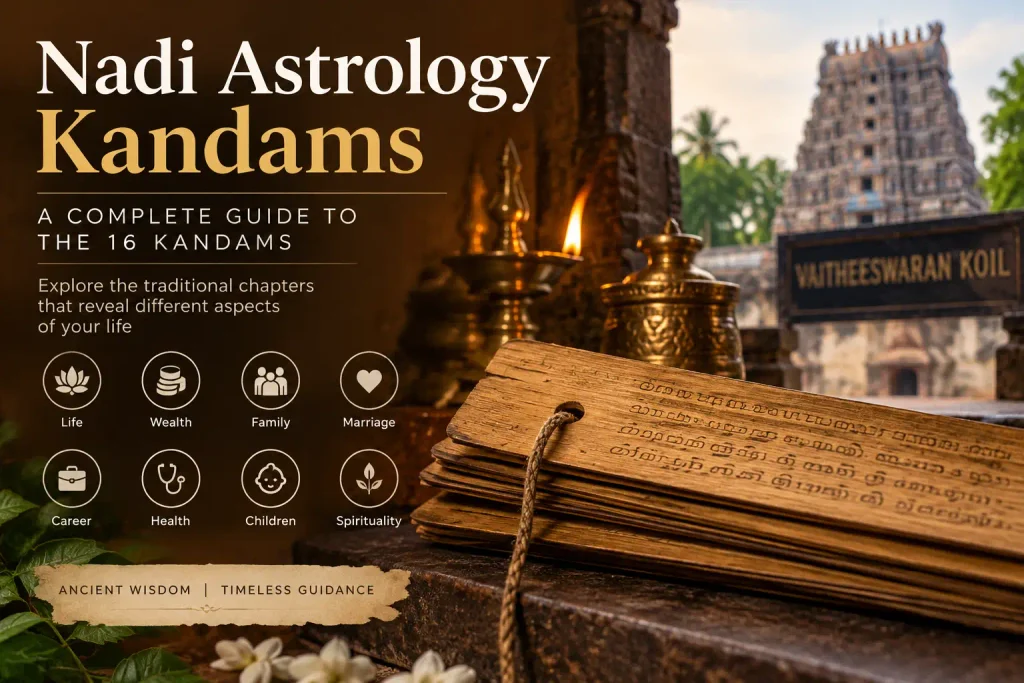
If you are planning a Nadi Astrology reading for the first time, understanding the Kandams can help you know what each chapter is traditionally associated with and decide which areas are relevant to your questions.
What Are Nadi Astrology Kandams?
Understanding the Kandams can help you learn what each chapter traditionally covers and identify which Nadi Astrology chapters are most relevant to the questions you want to explore.
The traditional system is commonly described as having 16 Kandams. The first Kandam gives a general overview, while the other chapters deal with more specific subjects.
The purpose of a Kandam is not simply to provide a prediction. Traditionally, it is used to organise the reading around a particular subject so that the seeker can explore questions relevant to their life. Those interested in understanding this traditional reading process can learn more about Vaitheeswaran Koil Nadi Astrology, where Nadi palm-leaf readings are traditionally associated with the study of different Kandams.
How Many Kandams Are There in Nadi Astrology?
Nadi Astrology is commonly described as having 16 Kandams. Each Nadi Astrology chapters traditionally focuses on a different area of life. Kandam 1 is generally treated as the introductory or general chapter, while later Kandams cover subjects such as wealth, siblings, home, children, marriage, profession, health, longevity, and spiritual matters.
Because practices differ between traditions, it is useful to ask the Nadi centre which Kandam system it follows before beginning a reading.
List of Nadi Astrology Kandams
Here is a simple overview of the commonly described 16 Kandams:
| Kandam | Traditional subject |
| Kandam 1 | General life overview |
| Kandam 2 | Wealth, family and education |
| Kandam 3 | Siblings, courage and communication |
| Kandam 4 | Mother, home, property and comforts |
| Kandam 5 | Children and related matters |
| Kandam 6 | Health, debts and difficulties |
| Kandam 7 | Marriage and relationships |
| Kandam 8 | Longevity and major life changes |
| Kandam 9 | Father, fortune and spirituality |
| Kandam 10 | Career, profession and business |
| Kandam 11 | Gains, friendships and fulfilment |
| Kandam 12 | Expenses, foreign matters and spiritual release |
| Kandam 13 | Karma and past-life-related matters |
| Kandam 14 | Remedies and spiritual guidance |
| Kandam 15 | General or special predictions |
| Kandam 16 | Spiritual or deeper life-related matters |
The exact description of some chapters can vary according to the Nadi tradition and manuscript system being followed.
Kandam 1: General Kandam
Kandam 1 is generally considered the starting point of a Nadi reading.
It provides a broad picture of the seeker’s life and may traditionally discuss personal identity, family background, education, occupation, marriage, children and general life circumstances.
The first Kandam is particularly important because it provides the foundation for moving into more specific chapters.
In many Nadi reading traditions, the seeker first needs to establish that the identified leaf or reading corresponds to them before proceeding with detailed Kandams.
Kandam 2: Wealth and Family
Kandam 2 traditionally focuses on wealth, family circumstances, education and related personal matters.
Questions may involve financial patterns, family relationships, learning, speech or communication. Some traditional descriptions also associate this chapter with vision and other related matters.
People interested in understanding their financial direction or family-related questions may therefore ask about the second Kandam.
A traditional reading should be understood as cultural or spiritual guidance rather than a guaranteed financial forecast.
Kandam 3: Siblings and Courage
Kandam 3 is traditionally associated with siblings, courage, communication and personal initiative.
The reading may discuss the number or nature of siblings and the relationship between the seeker and their brothers or sisters.
Some descriptions also connect this chapter with areas such as ears and communication.
For someone with questions about sibling relationships or personal confidence, this Kandam may be relevant.
Kandam 4: Mother, Home and Property
Kandam 4 traditionally deals with the mother, home, property, vehicles and comforts.
This chapter can be of interest to people who want to explore traditional Nadi interpretations concerning their home environment, property matters or relationship with their mother.
Some Nadi traditions also connect this Kandam with domestic happiness and material comforts.
Kandam 5: Children
Kandam 5 focuses traditionally on children and matters related to having children.
Depending on the Nadi tradition, the reading may discuss children, their future, family circumstances and traditional remedial practices.
Some Nadi sources also associate this Kandam with questions concerning conception and difficulties related to childbirth.
Because pregnancy and fertility are medical subjects, Nadi readings should not replace advice, diagnosis or treatment from a qualified healthcare professional.
Kandam 6: Health, Debts and Difficulties
Kandam 6 is commonly associated with health-related concerns, debts, obstacles, conflicts and difficulties.
Traditionally, this chapter may be used to discuss challenges that a person could encounter and suggested spiritual or traditional remedies.
Health predictions should be approached carefully. A spiritual reading cannot establish a medical diagnosis, determine treatment, or replace professional healthcare.
Kandam 7: Marriage and Relationships
Kandam 7 is one of the most commonly searched Nadi Astrology Kandams because it traditionally focuses on marriage.
It may discuss marriage timing, spouse-related matters, relationship circumstances and married life.
People often ask questions such as:
- When is marriage traditionally indicated?
- What qualities may be associated with the spouse?
- Are there traditional indications concerning married life?
- What remedies are recommended within the Nadi tradition?
Different Nadi centres may interpret marriage-related information differently, so the reading should be understood within the specific tradition being followed.
Kandam 8: Longevity and Major Changes
Kandam 8 is traditionally connected with longevity, major transformations and significant challenges.
This is one of the more sensitive Kandams because questions about lifespan can cause unnecessary fear or anxiety.
A responsible Nadi practitioner should communicate sensitive subjects carefully rather than presenting uncertain predictions as guaranteed events.
Kandam 9: Father, Fortune and Spirituality
Kandam 9 traditionally relates to the father, fortune, higher learning, spirituality and religious or philosophical interests.
It may be relevant to people interested in questions about spiritual development, traditional beliefs, pilgrimage or broader life purpose.
This Kandam is often viewed as having a stronger connection with fortune and spiritual direction.
Kandam 10: Career, Profession and Business
Kandam 10 traditionally focuses on professional life.
It may cover areas such as:
- Career direction
- Profession
- Employment
- Business
- Workplace development
- Professional opportunities
- Changes in occupation
For working professionals and business owners, this can be one of the most relevant Nadi Astrology Kandams.
Career decisions, however, are best made by considering practical factors such as skills, experience, financial circumstances, market conditions and personal goals alongside any spiritual or cultural guidance.
Kandam 11: Gains and Fulfilment
Kandam 11 is traditionally associated with gains, income-related outcomes, friendships, networks and fulfilment of desires.
The chapter may be interpreted in relation to social connections, opportunities and the results of efforts.
Its focus makes it particularly relevant to questions about progress, achievements and aspirations.
Kandam 12: Expenses, Foreign Matters and Spiritual Release
Kandam 12 traditionally deals with expenses, losses, foreign connections, isolation and spiritual release.
Depending on the tradition, it may also be connected with travel or living away from one’s birthplace.
People interested in overseas opportunities or spiritual development may therefore ask whether this Kandam is relevant to their reading.
Kandam 13: Karma and Past-Life Matters
Kandam 13 is often described in Nadi traditions as a chapter associated with karma and past-life-related information.
The interpretation can vary considerably between practitioners.
It is important to remember that claims about past lives and karma are matters of spiritual or religious belief rather than scientifically established facts. A trustworthy explanation should make that distinction clear.
Kandam 14: Remedies
Kandam 14 is traditionally associated with remedies.
Depending on the Nadi tradition, suggested remedies may involve prayers, temple visits, charitable activities, spiritual practices or other traditional observances.
Remedies should be approached as part of the cultural and spiritual practice of Nadi Astrology rather than as guaranteed solutions to medical, financial or legal problems.
Kandam 15: General or Special Predictions
Kandam 15 may be described differently depending on the Nadi tradition.
Some systems treat it as a special chapter containing additional predictions or information that does not fit neatly into the earlier Kandams.
Because there is no single universally standardised description of every Kandam across all Nadi centres, it is worth asking the practitioner how their manuscript tradition defines this chapter.
Kandam 16: Spiritual and Deeper Matters
Kandam 16 is generally associated with deeper spiritual subjects in traditions that include it as a separate chapter.
It may involve spiritual development, religious practices, life purpose or other matters beyond everyday concerns.
Again, the exact interpretation depends on the Nadi tradition and practitioner.
Which Nadi Kandam Should You Choose?
You do not necessarily need every Kandam.
The right choice depends on the questions you want to explore.
For example:
- General life questions: Kandam 1
- Money and family: Kandam 2
- Siblings: Kandam 3
- Home and property: Kandam 4
- Children: Kandam 5
- Challenges and traditional remedies: Kandam 6
- Marriage: Kandam 7
- Career or business: Kandam 10
- Gains and aspirations: Kandam 11
- Foreign matters: Kandam 12
- Karma: Kandam 13
- Remedies: Kandam 14
A practitioner can explain which chapters are available within their particular Nadi tradition.
Final Thoughts on Nadi Astrology Kandams
Understanding the Nadi Astrology Kandams can make a traditional Nadi reading easier to follow. Each chapter is generally connected with a different part of life, from family and wealth to marriage, career, children, spirituality and traditional remedies.
The most important point is that Kandam classifications can vary between Nadi traditions. Therefore, before choosing a reading, ask the practitioner which manuscript tradition they follow, what each Kandam covers, and whether the information is being presented as traditional guidance rather than guaranteed fact.
For readers researching Nadi Astrology online, a useful approach is to compare explanations from established sources and focus on transparent information about the reading process. This provides a clearer understanding of the tradition without making unsupported promises about future events.
Frequently Asked Questions About Nadi Astrology Kandams
How many Kandams are there in Nadi Astrology?
Nadi Astrology is commonly described as having 16 Kandams, although the way the chapters are grouped and named can differ between Nadi traditions and centres.
Which Kandam is for marriage?
Kandam 7 is traditionally associated with marriage, spouse-related matters and married life.
Which Kandam is for career?
Kandam 10 is traditionally associated with profession, career, employment and business matters.
Which Kandam is for children?
Kandam 5 is traditionally associated with children and related family matters.
Is Kandam 1 necessary?
Kandam 1 is generally treated as the introductory or general chapter. It helps establish the broader context of the reading before exploring more specific subjects.
Are Nadi Astrology predictions scientifically proven?
Nadi Astrology is a traditional spiritual and astrological practice. Its predictions should not be presented as scientifically proven facts. People who consult Nadi Astrology may approach it for cultural, spiritual or personal reasons.