Vaitheeswaran Koil is one of the well-known ancient Shiva temples in Tamil Nadu. Located in the Mayiladuthurai district, the temple is closely connected with the worship of Lord Shiva as Vaidyanathar, the divine healer. Over the centuries, the temple has become an important place of worship for devotees who come to pray for health, spiritual peace and family well-being.
The history of Vaitheeswaran Koil is not limited to the temple building alone. Its identity has been shaped by ancient Tamil devotional literature, local traditions, temple inscriptions, sacred legends and the continuing practices followed by devotees. The place is also associated with Lord Murugan, the Navagraha tradition and the ancient Saivite heritage of the Cauvery region.
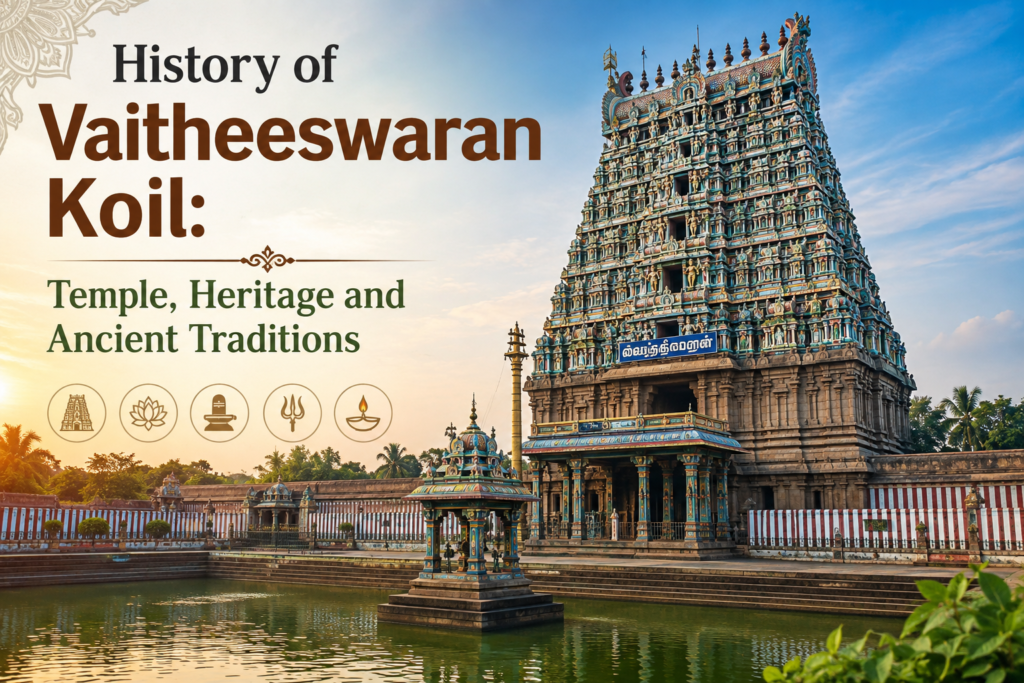
The temple is traditionally identified with the ancient name Pulirukkuvelur, which appears in the Tamil devotional tradition. It is also recognised as a Paadal Petra Sthalam, meaning it is among the Shiva temples praised in the hymns of the Nayanmar saints. These literary connections make Vaitheeswaran Koil an important part of Tamil temple history.
Where Is Vaitheeswaran Koil Located?
Vaitheeswaran Koil is situated in the Mayiladuthurai region of Tamil Nadu, between Mayiladuthurai and Sirkazhi. The temple and the surrounding town have developed as an important pilgrimage centre over many generations.
The place is important in that there is a strong presence of ancient temples in this area of Tamil Nadu in relation to the Cauvery delta region and the Tamil Saivite cult tradition. Many temples in this region are associated with the hymns of the Nayanmars and are important for studying the development of Tamil devotionalism.
The local government’s official tourist information office refers to the temple at Vaitheeswaran Koil as one of the ancient temples related to Vaithyanathan, Nayaki and Muthukumarasamy, and Angaraka or Mars under Navagraha tradition.
The Ancient Name: Pulirukkuvelur
An aspect of interest about the history of the Vaitheeswaran Koil temple is its traditional name, Pulirukkuvelur.
This name has been recorded in the Tamil Saivite religious tradition in relation to the temple in Thevaram songs. This association is significant as Thevaram represents one of the most prominent sources that describe the religious scenario of medieval Tamil Nadu.
Nayanmars were saints who visited different Shiva temples and wrote devotional songs in praise of the gods and sacred spots they encountered during their trips. The Vaitheeswaran Koil temple was one of these spots.
As such, due to its literary past, the temple represents more than just an ancient construction. It represents an active part of the religious literary tradition of Tamil Nadu.
Why Is Shiva Called Vaidyanathar Here?
The history of Vaitheeswaran Koil is a mix of the recorded history and the current religious practice. With the Chola connection, the Thevaram songs, Pulirukkuvelur, the practice of worshiping Vaidyanathar, Lord Murugan and the Navagraha culture, this temple has a special status in the culture of Tamil Nadu.
The identity of the temple as a sacred place which provides healing powers has been carried forward through the generations, and the inscriptions along with the literary links add value by connecting the present with the past of the area. While all that exists side-by-side with the tradition of worship at Siddhamirtham, prayer to Thayalnayaki and Angaraka, and also the practice of Nadi astrology in the town.
For any person who has an interest in the history of Tamil temples or Tamil literature or culture of the Cauvery area, Vaitheeswaran Koil holds lot more than just being a place of worship.
Vaitheeswaran Koil and the Chola Period
The Chola period is an important segment of the larger history of temple building in the Cauvery delta region, and the Vaitheeswaran Koil temple is known to have associations with medieval Cholas as well.
According to Incredible India, the temple has five inscriptions, most of which pertain to the reign of Kulothunga Chola I. These inscriptions give information about certain construction work done at the temple as well as donations to it.
The inscriptions in a temple are an invaluable source of data that cannot be found in myths. While myths give us the spiritual significance of the temple, inscriptions can give us information about patronage, donations, administration, and construction of the religious institution.
Thus, while talking about the history of the Vaitheeswaran Koil temple, it is important to recognize two different types of heritage of the place: the heritage of myths and worship and the heritage of inscriptions and literature.
.
Vaitheeswaran Koil in Tamil Saivite Tradition
Vaitheeswaran Koil enjoys a distinguished position in Tamil Saivism owing to its association with the Nayanmar devotion movement.
It has been classified as one of the Paadal Petra Sthalams – a collection of Shiva temples which have been extolled in the Thevaram hymns by Tamil Saivite saints. According to Incredible India, the temple has been linked to the Thevaram hymns of the Saiva Nayanmars from the 7th century AD.
This literary background provides Vaitheeswaran Koil with a distinct significance apart from the architectural features of the temple.
The Thevaram hymns ensured the preservation of the names and sanctity of numerous ancient Shiva temples. They also reveal the development of temple worship, pilgrimage, and Tamil devotional poetry as related concepts.
Thus, for travelers interested in Tamil culture, the visit to the Vaitheeswaran Koil temple means an experience of all these aspects combined.
The Connection With Lord Murugan
Murugan is also significant as far as the religious identity of the Vaitheeswaran Koil temple goes.
The temple has a shrine dedicated to Muthukumarasamy, which is yet another name of Murugan. Myths connected to the temple have Murugan linked to the temple and its religious heritage.
The presence of the shrines for Shiva, Shakti, and Murugan worship makes it evident that the temple is connected with the wider scope of religious traditions of the region of Tamil Nadu.
There are many divine forms worshipped at one temple in this region.
Vaitheeswaran Koil as a Navagraha Temple
Angaraka or the planet Mars has been another important aspect associated with Vaitheeswaran Koil.
Vaitheeswaran Koil is said to be the Angaraka or Sevvai temple out of the Navagraha temples in Tamil Nadu. As per the local government information, the temple has been classified as one of the holy places related to Angrahan or Sevvai (Mars).
There exists a separate Angaraka shrine inside the temple complex.
Traditionally, devotees pay visits to this shrine during their practice concerning Mars.
This factor has contributed towards making the temple an important pilgrim site for people who are interested in the worship of Shiva as well as the Navagraha tradition.
In addition to the above reasons, this temple has been discussed a lot while talking about traditional astrology and spirituality in Tamil Nadu.
The Sacred Siddhamirtham Tank
The Siddhamirtham tank is also an integral part of the temple complex.
The temples’ tanks have always been very significant elements of temple culture in South India. These tanks are used for rituals and are often seen as sacred elements of the temple environment.
In Vaitheeswaran Koil temple, Siddhamirtham is known as being linked with the temple’s healing tradition. The beliefs in the sacredness of its water are inherent to devotees.
As explained by Incredible India, devotees usually take a holy bath in the temple’s tank before worshipping and perform some customary rituals related to their requests.
Thayalnayaki Amman and the Healing Tradition
Thayalnayaki Amman is the goddess worshipped at Vaitheeswaran Koil.
The importance of the shrine of Thayalnayaki at the temple is immense, and it is associated with the healing concept at the temple. The presence of Thayalnayaki and Vaidyanathar at the temple gives spiritual importance to the temple with regard to care and well-being.
There is also a shrine for Dhanvantari, who has an association with medicine and healing. Besides, there is a neem tree, which has an association with the traditional medicine system, at the temple complex.
These factors should be considered while connecting the temple and healing concept.
Architecture and Temple Heritage
The goddess of the temple of Vaitheeswaran Koil is Thayalnayaki Amman.
The importance of the shrine of Thayalnayaki is high and is connected to the idea of healing in the temple. The presence of both Thayalnayaki and Vaidyanathar gives the spiritual importance of the temple concerning care, protection, and well-being.
There is also a shrine of Dhanvantari who is connected with medicine and healing. Moreover, there is also a neem tree which is connected to medicine in the temple.
All this information can be considered while discussing the connection between the temple and the idea of healing.
Vaitheeswaran Koil and Nadi Astrology
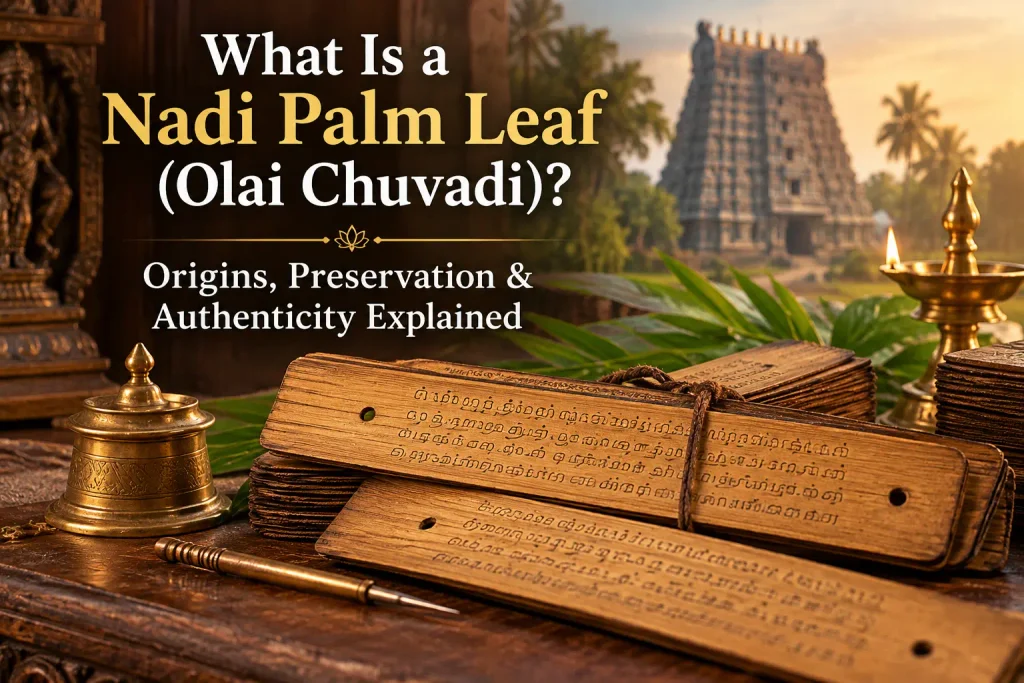
In recent times, the town of Vaitheeswaran Koil has gained much fame beyond Tamil Nadu because of Nadi astrology that uses palm-leaf manuscripts as an ancient practice.
Vaitheeswaran Koil Nadi astrology is not a part of the recorded history of architecture and inscriptions of the temple. However, it has developed into an inseparable part of the culture of the town and of its pilgrim culture.
People visit Vaitheeswaran Koil not only for the worship of the temple but also because they have an interest in the ancient practices of spirituality. It has helped the town to gain its reputation as a place connected with temple history and Nadi astrology.
However, Nadi astrology should be presented as an ancient practice or belief system and not as an evidence-based technique for prediction of one’s future life.
Why Vaitheeswaran Koil Remains Important Today
The importance of Vaitheeswaran Koil comes from the way several layers of history continue to exist together.
It is an ancient Shiva temple. It is connected with Tamil Saivite literature. It has inscriptions associated with medieval Chola patronage. It has a strong Murugan tradition and a Navagraha association with Mars. It also preserves rituals, festivals and customs that continue to attract devotees today.
This combination makes the temple more than a historical monument.
It is a living temple, where history is perceived through worship, architecture, festivals, sanctified areas, and local tradition.
To a visitor, having this context will allow the visit to the temple to be more significant and informative. Instead of just focusing on the gopuram and the shrines, the visitor can understand the many historical layers that make up the history of Vaitheeswaran Koil.
Conclusion
The history of Vaitheeswaran Koil is a mix of the recorded history and the current religious practice. With the Chola connection, the Thevaram songs, Pulirukkuvelur, the practice of worshiping Vaidyanathar, Lord Murugan and the Navagraha culture, this temple has a special status in the culture of Tamil Nadu.
The identity of the temple as a sacred place which provides healing powers has been carried forward through the generations, and the inscriptions along with the literary links add value by connecting the present with the past of the area. While all that exists side-by-side with the tradition of worship at Siddhamirtham, prayer to Thayalnayaki and Angaraka, and also the practice of Nadi astrology in the town.
For any person who has an interest in the history of Tamil temples or Tamil literature or culture of the Cauvery area, Vaitheeswaran Koil holds lot more than just being a place of worship.
Frequently Asked Questions About Vaitheeswaran Koil History
How old is Vaitheeswaran Koil?
Vaitheeswaran Koil is an ancient temple with a long history connected with Tamil Saivite devotional traditions. Its historical importance is supported by literary references and temple inscriptions, including inscriptions associated with the Chola period.
What is the ancient name of Vaitheeswaran Koil?
The temple is traditionally associated with the ancient name Pulirukkuvelur, which is found in the Tamil devotional tradition.
Who is the main deity of Vaitheeswaran Koil?
The main deity is Vaidyanathar, a form of Lord Shiva traditionally associated with healing. The goddess is worshipped as Thayalnayaki.
Why is Vaitheeswaran Koil associated with Mars?
Vaitheeswaran Koil is traditionally regarded as the Navagraha temple associated with Angaraka or Sevvai (Mars). A dedicated shrine for Angaraka is located within the temple complex.
Is Vaitheeswaran Koil a Paadal Petra Sthalam?
Yes. Vaitheeswaran Koil is recognised as a Paadal Petra Sthalam, reflecting its place in the Tamil Saivite devotional tradition and its association with the Thevaram hymns.
Is Nadi astrology part of the temple’s ancient history?
Nadi astrology is a traditional practice strongly associated with the town today. However, it should be distinguished from the temple’s documented history through inscriptions and Tamil devotional literature.